

Ctrl-Alt-Health, Page 4 of 7
Reboot your digital practice
Welcome to Ctrl-Alt-Health, the Contensive blog where healthcare meets digital innovation. We help medical practices take control, reset what’s not working, and optimize their online presence to attract and retain more patients. From website design and SEO to patient experience and automation, Ctrl Alt Health delivers practical insights for running a healthy, high-performing digital practice.
The One-Star Review You Can't Remove — And What It's Actually Doing to Your Practice

A patient leaves a one-star review. You know they were never actually unhappy with the care. They went to the wrong location — your old address, still live on a directory you forgot about — waited, gave up, and blamed you. Now the review sits on your Google profile, and you can't get it taken down because technically, from Google's perspective, it describes a real experience.
This is not a rare scenario. It happens to medical practices every week, and most of them don't find out until someone mentions it in passing — or until they Google themselves.
Why Bad Reviews Stick (Even When They're Wrong)
Google's review removal policy is narrow. Reviews can be removed if they contain hate speech, personal information, or clear conflicts of interest. "Patient showed up at wrong location due to outdated listing data" does not qualify. The review stays.
What makes this worse is the asymmetry of impact. Research on consumer behavior consistently shows that negative reviews carry more weight than positive ones. A single one-star review can offset the influence of multiple five-star reviews, particularly when it's recent or when the response (if any) is defensive.
The Root Cause: Listing Data You Don't Control
The outdated address problem is almost never the practice's fault in a straightforward way. You updated your Google Business Profile when you moved. But there are dozens of other directories — Yelp, Healthgrades, Zocdoc, WebMD, Vitals, insurance provider directories, hospital affiliation pages — that pull and redistribute your practice information independently.
Some of them sourced your old address years ago and never updated it. Some of them don't allow you to claim or edit your own listing. Some of them feed data to other platforms, meaning one stale record can propagate across multiple sites.
The patient who went to the wrong location didn't make a mistake. They followed the information the internet gave them.
What You Can Do
Audit your full listing footprint
Start by searching for your practice name on Google, Yelp, Healthgrades, WebMD, and your insurance carrier's provider directory. Compare the address, phone number, and hours on each one against your current information. Note every discrepancy.
Respond to the review strategically
You can't remove the review, but you can respond. A response that acknowledges the frustration, clarifies the listing error, and shows you've corrected it does two things: it signals to future patients reading the review that the problem was a data error, not a care problem, and it demonstrates that your practice pays attention and responds.
Request removal only when policy-compliant
If you can demonstrate that the reviewer never actually visited your practice (because they went to an old location you no longer operate), it's worth requesting a review removal through Google's process. Success is not guaranteed, but it's worth attempting.
Accelerate legitimate positive reviews
The most durable response to a one-star anomaly is a healthy volume of verified positive reviews. A systematic approach — asking satisfied patients at checkout, following up with a text the day after their visit, and making the link easy to find — shifts the overall rating and reduces the relative weight of outlier reviews.
Not sure how your practice listing looks across the internet? Get a free audit at contensive.com/free-medical-website-audit
The Online Booking Gap: Why Patients Who Want to See You Still Can't Get In
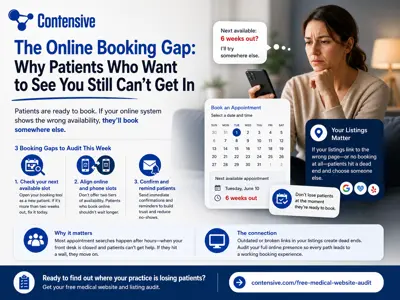
It's 10:47 PM on a Tuesday. A patient finishes reading about their symptoms, decides they need to see a specialist, and pulls up their phone to find one. They find your practice. They click "Book Online." The next available appointment is six weeks out.
They close the tab and try the next result.
You never knew they were there.
The Hidden Waiting Room Problem
Most practice managers think of their booking system as a convenience feature. In 2026, it is a gatekeeping system — and if it's misconfigured, it is quietly turning away patients who were already sold on seeing you.
The specific failure mode looks like this: your scheduling software shows real-time availability, but it's showing the wrong slots. It might be blocked by buffer times that are too long, by template errors that mark half your week as unavailable, or by online-booking rules that only surface appointments weeks out while your front desk can get someone in Thursday.
The patient doesn't know any of that. They just see "next available: 6 weeks" and assume you're booked. They move on.
Why After-Hours Is When This Matters Most
The majority of online appointment searches happen outside business hours — evenings and weekends, when patients have time to think, research, and act. This is also when your front desk is unavailable to correct the booking system's gaps.
That means the patients most motivated to schedule — the ones who sat down, researched their condition, decided on your practice, and opened the booking tool — are hitting a wall at exactly the moment they're ready to commit.
See your practice the way a prospective patient does
The free medical website scan is a read on your current digital patient experience — scheduling, communication, trust signals, mobile — benchmarked against what large systems are actually offering right now. Results inside 24 hours.
Three Booking Gaps to Audit This Week
1. What does your next available slot look like online right now?
Open your booking tool as if you're a new patient. Don't go through the admin portal — use the public-facing link. What's the first available appointment? If it's more than two weeks out and your front desk can actually get someone in sooner, you have a configuration problem worth fixing today.
2. Are your online slots the same as your phone slots?
Many practices inadvertently create two tiers of availability: a limited set of "online" slots (often residual or less desirable times) and a fuller set of slots accessible only by phone. Patients who book online see a sparse calendar. Patients who call get in faster. In 2026, a significant portion of patients will never call — they'll just leave.
3. Does your system send confirmation and reminder messages?
A booking gap isn't always about availability. It's also about trust. Patients who book online want to know the appointment is real. An immediate confirmation email or text, followed by a reminder 48 hours before the visit, closes the loop and dramatically reduces no-shows.
The Connection to Your Online Listings
Your booking gap gets worse when your online listings are out of sync. If your Google Business Profile or health directory listings link to a broken booking page, an old portal, or no booking option at all, patients who arrive from those sources have no path forward. They came ready to schedule and found a dead end.
This is why an audit of your full online presence — not just your website, but every directory and platform where your practice appears — is the starting point for plugging the booking gap.
Ready to find out where your practice is losing patients? Get your free medical website and listing audit below.
Mid-Series Recap: Our 6 Most-Clicked Articles on Medical Practice Marketing
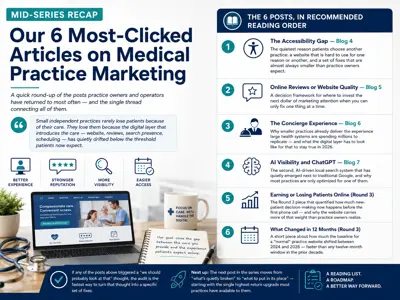
A quick round-up of the posts practice owners and operators have returned to most often — and the single thread connecting all of them.
Over the past several weeks we’ve published a short series on the specific, fixable reasons medical practice websites quietly lose new patients. Enough practice owners have written in or asked us follow-up questions that we’re pulling the most-read pieces into a single place — both as a reading list and as a map of where the series is going next.
This post is intentionally short. It is meant to be a re-entry point, not a new deep-dive. If you have time for only one of the linked articles, read Blog 7 (AI Visibility) — it’s the one most practices are most behind on and the one closest to becoming an active new-patient acquisition problem.
The six posts, in recommended reading order
1. The Accessibility Gap — Blog 4
The quietest reason patients choose another practice: a website that is hard to use for one reason or another, and a set of fixes that are almost always smaller than practice owners expect.
2. Online Reviews or Website Quality — Blog 5
A decision framework for where to invest the next dollar of marketing attention when you can only fix one thing at a time.
3. The Concierge Experience — Blog 6
Why smaller practices already deliver the experience large health systems are spending millions to replicate — and what the digital layer has to look like for that to stay true in 2026.
4. AI Visibility and ChatGPT — Blog 7
The second, AI-driven local search system that has quietly emerged next to traditional Google, and why most practices are only optimized for one of them.
5. Earning or Losing Patients Online (Round 3)
The Round 3 piece that quantified how much new-patient decision-making now happens before the first phone call — and why the website carries more of that weight than practice owners realize.
6. What Changed in 12 Months (Round 3)
A short piece about how much the baseline for a “normal” practice website shifted between 2024 and 2026 — faster than any twelve-month window in the prior decade.
What the series has in common
Reading back through the posts, the single most common thread is also the most actionable one. Small independent practices rarely lose patients because of their care. They lose them because the digital layer that introduces the care — website, reviews, search presence, scheduling — has quietly drifted below the threshold patients now expect.
That drift is invisible from inside the practice. It is obvious from outside. And the entire point of the audit, and of this series, is to close that gap without requiring a full rebuild, a new agency, or an enterprise budget.
If any of the posts above triggered a “we should probably look at that” thought, the audit is the fastest way to turn that thought into a specific set of fixes.
Thanks for reading. The next post in the series moves from “what’s quietly broken” to “what to put in its place” — starting with the single highest-return upgrade most practices have available to them.
When a Patient Asks ChatGPT for a Doctor Near Them, Does Your Practice Come Up?
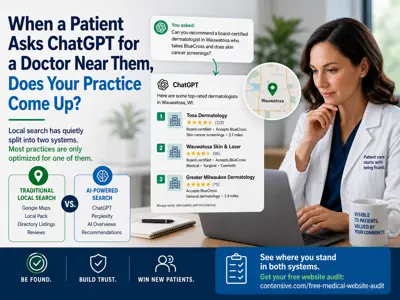
Local search has quietly split into two systems. Most practices are only optimized for one of them.
Ten years ago, a patient looking for a new dermatologist in a specific town did one thing: they typed “dermatologist near me” into Google, scanned the first page of results, and called whichever listing looked most credible. That was the game. Practices that ranked for local searches won. Practices that didn’t, lost.
That game still exists. But there is now a second one running alongside it — and most practice owners have not yet realized they are playing it.
Patients are increasingly asking AI tools like ChatGPT, Perplexity, and Google’s own AI Overviews to recommend a doctor. They type a natural-language question — “Can you recommend a board-certified dermatologist in [town] who takes BlueCross and does skin cancer screenings?” — and the AI returns a short list of specific practices. Not a page of blue links. A recommendation.
If your practice is not on that short list, you are invisible to a growing, increasingly important category of patient search — and no traffic report will tell you about it, because there is no click to measure.
Two different visibility systems, same patient
Traditional local search visibility depends on a familiar set of factors: a complete and current Google Business Profile, consistent name-address-phone (NAP) information across the web, review recency and volume, website content that signals your specialty and location, and technical health of the site itself.
AI-powered search visibility depends on those same fundamentals, plus some that are newer. AI tools read structured data on your website, look for clear plain-language descriptions of your services, give more weight to third-party corroboration (directories, health review sites, practice listings), and heavily favor practices with recent, specific reviews. They also have a bias that traditional search does not: they prefer practices with clean, crawlable websites over visually impressive ones that hide information inside images or custom scripts.
The uncomfortable implication is that a practice can be perfectly fine in traditional Google search and still be almost invisible to AI search — because AI prioritizes slightly different signals.
Why this shift is accelerating faster than practices expect
Patient behavior around AI search is moving faster than most industries internalize. Patients who already use ChatGPT for other questions are carrying that habit into healthcare. A 34-year-old parent researching a pediatrician is now as likely to ask Perplexity for a recommendation as to scroll through Google’s local pack. A newly retired patient relocating to a new town might ask ChatGPT what to look for in a primary care practice — and ChatGPT will cite specific practices by name.
For a practice, the asymmetry is steep. The cost of being included in AI recommendations is modest — it usually means tightening the same fundamentals that help traditional search. The cost of being excluded is a slow, invisible leak of a growing segment of new-patient search volume.
|
See where you stand in both systems Our free medical website audit checks your practice against the signals both Google’s local search and the major AI search tools use to choose which practices to surface. You’ll see exactly what is working, what is missing, and what to prioritize. Get your free website audit at contensive.com/free-medical-website-audit |
The five signals that drive local + AI visibility for medical practices
1. Google Business Profile completeness and recency
The single highest-impact asset most practices underuse. A Google Business Profile that has accurate hours, a current service list, recent photos, responses to reviews, and regular updates is the foundation of both traditional local search and AI recommendations. A profile that is 60% filled in and has not been touched in a year is the fastest thing most practices can improve.
2. Review recency and response
Both Google and AI search models weigh recent reviews much more heavily than older ones. A practice with 80 five-star reviews, none in the past 12 months, looks inactive. A practice with 25 reviews, five of them in the past month, looks like a thriving going concern. Review volume matters less than it used to; review recency matters more.
3. Listing consistency across the web
Your practice name, address, phone number, hours, and specialty need to match across Google, Healthgrades, Vitals, Zocdoc, your state medical board listing, and any insurance directories. Inconsistency — an old address on one site, a closed phone line on another — is a signal to search algorithms that your data is unreliable, and it suppresses visibility in both traditional and AI search.
4. On-site content that describes what you actually do
Practices that publish clear, plain-language descriptions of their conditions, procedures, and differentiators consistently outperform practices with generic “we offer compassionate care” copy — both in Google and in AI recommendations. AI tools, in particular, prefer practices whose websites make it easy to answer specific patient questions.
5. Technical health of your website
Mobile performance, page speed, structured data, and readable source code all matter. A beautiful site that hides information inside images or poorly written code is less visible in AI search than a simple site with clean, crawlable content.
What most practice owners have never been told
The main reason AI search visibility is quietly underperforming at most practices is not that their websites are bad. It is that the bar moved and nobody told them. A site that was built in 2022 was built for Google’s traditional local pack. The behaviors and signals that drive AI recommendations did not exist at scale yet. The site may still work for its original purpose — and still be invisible to the fastest-growing segment of new-patient search.
This is not a technical problem. It is a bar-has-moved problem. And the fix is almost always a set of targeted updates to the same fundamentals that also improve traditional local search — meaning the work pays back in both systems at once.
A five-minute self-check
- • Open an incognito browser and search for your specialty plus your town. Are you in the top three local results?
- • Open ChatGPT or Perplexity. Ask it to recommend a [your specialty] in your town. Is your practice in the response?
- • Check your Google Business Profile — is every field filled in and current?
- • Look at your latest review — was it left in the last 30 days?
- • Search your practice name. Does the information match across Google, Healthgrades, and your insurance directory?
If any of those answers are no — or if you are not sure — you are not alone. Most practices we audit have at least two of these gaps, and most are unaware of them until someone looks.
See your practice the way a prospective patient does
The free medical website audit is a practitioner-to-practitioner read on your current digital patient experience — scheduling, communication, trust signals, mobile — benchmarked against what large systems are actually offering right now. Results inside 24 hours.
Get your Free website audit.
Request My Free Website Audit