

Tips to Provide the Best Website Experience, Page 19 of 25
Discover expert articles on website optimization, security, speed, and content management from Contensive. Learn strategies for building better web experiences.
Questions to Ask Your Web Development Company

Chances are your web redesign is not an in-house project. Too many variables go into a redesign for you to be sure it gets done just right. So to get the best possible result, you outsource the redesign to a web development company. But how can you be sure that you picked the right company for the project? By asking them these 7 questions before they begin.
What will it Cost?
The easiest question should also be your first. Web development companies vary wildly in costs, and many may not give you a clear response at first - citing too many variables as a reason. But getting a reliable quote is crucial, both to make sure it fits within your budget and to evaluate the honesty of the web developer.
What's the Timeline?
Similar to the first question, asking about a timeline can go a long way toward learning more about your potential web development partner. The more clear their projected timeline is, the more likely they are to stick to that timeline. But if it's a vague timeline with many qualifiers that could extend, you may want to seek out someone else.
Can You Design Responsively?
In 2015, responsive design is an absolute must for newly designed websites. The majority of internet usage now comes from mobile devices, which overtook desktop usage for the first time last year. That gap is only expected to grow in the near future. A responsively designed website, adjusting dynamically to the device and screen size used by your audience, is the only way to ensure quality user experience regardless of their device of choice.
But responsive design has benefits beyond user experience. Search engines like Google now take the mobile-friendliness of websites into account when ranking them in search results. All other things being equal, a responsive website will always rank higher than a non-responsive website on the same keyword. That's why your web development company should have the necessarily expertise to design your website responsively.
Agile or Waterfall?
We've covered the difference between agile and waterfall web development in a previous blog post. In short, it's the difference between a strict, methodical process and a more dynamic alternative that splits the design of your website into several "blocks" which get reviewed and improved continuously. In most cases, you'll want to go with a development company that offers agile development, in large part because of the next question:
Can We Review?
Naturally, you'll want some input into your new website. Traditional, "waterfall" development offers little opportunity to do so because by the time the website is in the testing stage, there may not be enough time to go back and make major changes. Instead, pick a web development company that's open to working with you instead of for you, taking your ideas and suggestions into account throughout the project.
What Actionables Will it Include?
Another essential part of your website are the calls to action on each page. A website can no longer be a static, idle marketing tool. It should offer visitors "next" steps, guiding them toward more content or a contact form. Ask your web development company what calls to action they'll build into your website, and how these calls to action will be managed on your end.
What Happens When It's Done?
Because your website should not be static, its development doesn't end with the finished product. Whether you want to make tweaks after the fact or change your calls to action and content, you need to know exactly how you can make those changes even after the contract with your web development company is finished. Will they continue to be available for these tweaks, or might they even train your staff on the backend of the website?
Getting satisfactory answers to each of these 7 questions ensures that you work with a web development company that's not just looking for some easy money, but is genuinely interested in getting you the best product necessary. Contact us today to see if we're the right fit for your website redesign project!
Creative Ideas for Mobile Apps (That You'll Wish Were Yours)
Taking a peek at the latest mobile app ideas in the tech world can be energizing -- the ideas that make you wish you had thought of that. It can be an effective pep talk.
Why?
Because we live in exciting times. In 2009, when Stanford University released online a free course on mobile app development, they saw one million downloads in seven weeks, according to their press release.
If the demand to create mobile apps was so high six years ago, it's no wonder that the tech world is now seeing jaw-dropping apps coming out in a relentless stream -- apps like the four below, hand-selected for your inspiration (and, yes, these are fun and lighthearted, but their brilliance will make you green with jealousy):
1. A Gaming App That Teaches Kids to Code
Codarica, a blossoming start-up, has found a way to teach kids to code -- according to their website:
"This iPad App allows children to build their first website with real HTML & CSS. Joining a magical journey through the world wide web, kids can test & hone their coding skills! Publish it when they are done!"
Their idea was so good that Disney's new (and widely admired) Startup-Accelerator Program selected Codarica for the 2014 accelerator program.
If we thought we live in exciting times, just wait until the next generation of coders grows up.
2. An App That Fixes...Potholes?
Although not the newest kid on the block, an app called Citizens Connect is still the leader in the world of civil government -- even six years after its launch. According to this article, the app has greatly improved that rough, unpaved intersection between citizens and city government:
Pioneering civic technologies is Boston, which has been touted as the first city to use a mobile app — Citizens Connect — to plug into its community. Launched in 2009, the app is designed similar to the city’s 311 hotline: Residents can report problems like potholes or graffiti by snapping a photo, tagging the location, and sending a report through the app. Users receive a tracking number and can monitor when the city fixes the issue.
Talk about government transparency: getting personal messages from the government alerting you to their progress in fixing a problem is, well, a concerned citizen's dream. If only someone could make an app to fix the potholes in Washington.
3. An App That Digitizes Household Chores (So Kids Want to Do Chores)
Chore Monster had a very simple idea: overlay the behavioral economics of video games -- the things that motivate players, like earning experience points, leveling up, and unlocking new game play features -- into the physical world -- namely, the kid's house.
10 years ago, when apps or touch-screen iPhones didn't exist, such a thing couldn't have been created -- at least not in the amazingly fun, easy way that Chore Monster did it. Their ChoreMonster app, which is used and synced between kid and parent, keeps track of their "experience points" that they gain as they do chores. And when they reach higher gaming levels -- set by the parents -- they "unlock" new features and prizes (i.e. the parent takes them out to ice cream, buys them something, let's them go to some fun event).
Frankly, we all wish we had that app when we were kids.
4. An App That Even Truckers Would Love
Our highly skilled team of engineers at Contensive are not shy to throw our hat into this ring. We've made some superb mobile apps too, and our LoadLog app is a perfect example.
The oil and gas fields of North Dakota is not exactly the place you'd expect to find the birth of a powerful, cutting edge app. It's not very Silicon Valley. And, if we're relying on stereotypes here, we wouldn't expect rough-neck truck drivers -- those tough, gritty types (both men and women) who spend their days (and nights) driving rural terrain in some of the roughest winter weather in the nation -- to be too concerned with the ideas of tech wizards who spend their days (and nights) in offices coding.
But, in this case, Contensive bridged that gap and came up with a highly innovative logistics app that has made the lives of these tireless truckers much easier. The LoadLog is a hybrid online application that relies on an SMS communication channel -- which is much more reliable in rural North Dakota than standard web communication -- that automates their load logistics and driver tickets and reduces the time-waste for the truckers who were constantly filling out paper tickets and expending energy to keep them all in order.
Truckers and coders make a good team after all.
And it is a dream come true for the dispatchers, who merely have to log into the application dashboard to see where every truck is located, and to see where the truck is in its workflow. They can issue new tickets to those truckers who are ready for another route and calculate average delivery times, which helps them set benchmarks for current times -- to name just a few of the many features we programmed into that powerful logistics app.
Let Us Help You Create Your Next Big Idea
If you're looking for mobile application development companies that are highly creative, responsive -- even to the smallest nuances of your product development and marketing plan (which, these days, are the same thing) -- contact us to find out what amazing things we can build for you.
Understanding the differences between Waterfall and Agile App/Web Development
Whether you're developing a website or an app, you always start with a concept. What should the website be about? What is its major goal? What problems does it solve for your audience? But after considering these major theoretical questions, it's time for the actual development - and that's where approaches start to differ. It's a battle of waterfall vs. agile, and only one of them can win.
The Traditional (Waterfall) Approach to Development
Traditionally, conception is the beginning of a step-by-step process. Imagine a waterfall: water can only fall one bit at a time, and has to hit the stones high up in the process before it gets closer to the bottom. After the concept comes an analysis of the current situation, followed by the actual design, which is then coded. When everything is done, it's time to test the website or app before it gets officially released to your audience.
Running into Problems
Unfortunately, the waterfall method of development comes with some serious issues. Most times, you will develop your app or website with a specific timeline and budget in mind. But what if you run out of either? What if the product needs to be launched in a week, and you haven't even gotten to the testing phase yet? If you've already begun promoting the release, the logical response is to skip the testing phase either partially or entirely. That, of course, can lead to serious problems and an unfinished product.
Waterfall is all about the upfront plan however, the above scenario can happen no matter how well-planned the project was. In theory, the waterfall method sounds perfect for allocating a certain amount of time for each step. Reality, however, looks quite different. While in theory it is nice to think that before a project begins you will be able to account for every scenario and use of the application the reality is you often create as you go and the scope begins to creep or the developers make assumptions based on written requirements. While the code amy fulfill a written requirement it may not be what the client envisioned and they won’t have any input until the end so change orders start to fly, budgets start to grow. You won't know if you've produced a good product (website or app) until the very end, when you have started to test it. As a result, you may spend much more time on the coding or design than you intended, leaving less time for testing than you actually need.
Of course, even if everything works out beautifully within your schedule and you allocate an even 25 percent of your time to testing, you may need more. You never know what issues pop up during the testing stage that you had no idea about. But if you discover a bug that happened early on, it may affect how the entire code was written. By strictly adhering to the inflexibility of a step-by-step process, you're suddenly running out of options.
The Agile Alternative
Fortunately, the waterfall method isn't the only way to develop a website or an app. All of the situations we described above can be fixed with an alternative approach, and its strength is in its name: agile development. Instead of looking at the analysis, design, coding and testing steps in succession, they all occur at once. The development is still split up into various stages. But these stages are separated not by type of work, but individual modules, completed in "sprints."
That, in turn, allows for a number of advantages. First, it greatly decreases the possibility of finding a mistake too late to do much about it. Testing is the final step for each sprint, allowing developers plenty of time to catch up and course correct before moving on.
Second, client input becomes more important. In waterfall development, you as a client will only be able to give you input in the beginning stages; after that, you essentially hand over the project to the developer and wait. Agile development encourages a collaborative approach: clients add feedback for each module, allowing the final website or app to move closer to their vision. Finally, choosing an agile method allows the developer to plan the project's timeline more easily, leading to a greater possibility that your website or app will be finished - even with added changes - within its intended timeline.
In short, agile development is the perfect solution if you're look for a new website or app in the near future. And if you are interested in finding out more, don't hesitate to contact us! We'll be happy to talk to you about the different processes and how agile development can benefit your business.
How a Scrum in Agile Development Assures a Customer Focus

Sustainable success in the current business climate requires the agility to respond rapidly to customers’ needs and concerns with ingenuity and innovation.
The old approach—engineers talking only to engineers, the production line talking only to those on the line, the head of QA talking only to the QA team, and the IT people sitting in cubicles—may have been good enough to satisfy shareholders, but simply is unable to adapt to the technology-based, customer-focused approach in today’s economic climate.
Satisfying customers now requires developing a complex product quickly. Some of the most successful, continuously innovative IT companies, such Google and Salesforce, for example, have incorporated Agile development, including scrums, to chunk down complex production processes to manageable short “sprints.”
In fact, scrum has become a lifeline for companies that value a customer-driven, innovative product focus. Here’s how.
What is a "scrum" in Agile development?
Scrum is talked about in a number of ways. In Agile development, it describes an approach to production that:
- encourages team self-organization, collaboration, creativity, and customer feedback;
- enables pivoting and refocusing as often as needed to incorporate rapid changes;
- seeks internal and external review with an eye towards continuous process improvement; and
- emphasizes on-time customers solutions.
Who participates?
Scrum.org describes the three roles essential to a scrum: the product owner, the Scrum Master, and the team.
- The product owner has the vision and authority to remind the team where their main focus needs to be and determine the deliverable for each sprint.
- The Scrum Master (SM) is the project’s chief facilitator—a type of symphony conductor who assists the professionals on the team by encouraging each one to play to his or her strengths while collaboratively “listening” to each of the other team members in order to deliver the right product on time and on budget.
- The team is a self-organizing, collaborative cross-section of professionals across functional divisions whose skills are required to develop the product. Scrum Methodology describes a scrum team this way: “a mix of software engineers, architects, programmers, analysts, QA experts, testers, and UI designers. Each sprint, the team is responsible for determining how it will accomplish the work to be completed.”
How does a scrum work?
The scrum approach is dynamic. It relies on the leadership skills and expertise of the SM who facilitates the development of the product in sprints.
Sprints —short spurts of production that allow for immediate course corrections based on product owner and/or customer feedback—not only continually ensure that the project is on track, they also help keep down costs and avoid wasted time. Because they are feedback loops, they are the foundation of a transparent process
- Once the product owner determines the deliverable for the next sprint, a scrum in Agile development requires the SM to plan the work and facilitate moving the team forward.
- Once the SM has checked in with the customer and/or product owner and received feedback, planning the next sprint can take place. Note that in effect, the customer becomes a partner in the process.
- The SM makes sure that team members each are on the same page and clear about the job definition and what will be required of them.
- A scrum in Agile development also requires the SM to identify and remove obstacles to keep the team moving forward, and ensure that the team has the right resources—human and tech-related—and the right timeframe to succeed.
Pivoting quickly and adapting to change is a hallmark of scrum.
Experienced teams get better and better at regarding pivots and changes as the norm. As with any great symphonic orchestra, the longer the project team has collaborated together, the smoother the collaboration and the easier it becomes to offer, receive, and incorporate process improvement feedback.
The scrum approach encourages new ideas, which is key to attracting and retaining customers. That approach only works if feedback is accepted as a normal part of the process, as it is in scrum. That is the reason scrum may well make the difference in successfully maintaining a focus on continuous innovation and customer satisfaction.
To learn more about how our Agile approach creates products that solve your customer requirements, please contact us today.
Measuring Customer Delight With User Stories
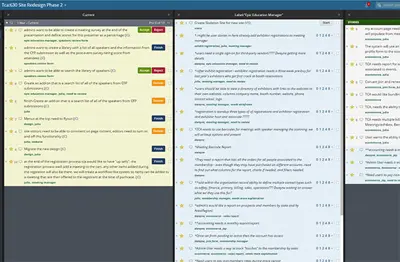
How to write User Stories for use in Agile Development
The era of shareholder capitalism is over. Market power has shifted to the customers, and consumers are now in charge. If businesses want to make money and survive, they can no longer shove products and services down the throats of buyers. In fact, they need to do more than simply satisfy their customers; they need to delight them.
Understanding the quality of the customer experience as opposed to counting up outputs, or ‘things delivered’, requires questions that get into the heads of consumers. Questions such as what is their current need, frustration, or experience looks at a product or service from a customer's view.
These insights can then be captured in the form of user stories. A user story is a simple narrative told from the perspective of someone who desires a new feature or experiences a problem. These short narratives give businesses access to what their customers think and feel, allowing companies to climb out of their self-centered profit hole, and into the minds of consumers. From this new perspective, businesses can begin to imagine what kind of product or service a customer wants, and most importantly, which kind will delight them.
Here Are 4 tips on how to employ User Stories in Agile Development
Starting Your Stories
Mike Cohn gives the basic form for the user story as such:
"As a (type of user), I want (some goal) so that (some reason)."
Notice the story is in first person. The effect this has on your team draws them into the mind of your clients and into their situation. By writing, “As a such-and-such, I want. . . ,” one instantly imagines what it is like to be that person.
Here are some concrete examples:
- As a parent, I want a better job, so that I can provide more for my family.
- As a business owner, I want employees that care about their work, so that we can offer better services to our customers.
- As a user of a blog, I want more features that improves my blog’s functionality, so that I can reach out and attract more readers.
Keep Your Stories Handwritten
User stories are often written down on index cards or sticky notes and showcased on walls or tables. Why this preference for handwritten notes over computers? Because information entered into a computer tends to become a fixed artifact, only accessible by one person at a time. However, the physical presence of handwritten notes sparks open conversations which enable software designers to explore new ways to delight their clients.
Remember, the story itself is less important than the discussion it facilitates. They serve as a starting point for new insights and inspirations that can make a product or service better.
Showcase Your Stories
The written story is not the final word, but the starting point for discussion. Displaying user stories tells everyone at a glance what has been completed, what is being worked on, and what remains to be done.The visibility and physical nature of handwritten notes channels the abstract requirements of software development into practical discussions towards what might delight and serve the customer.
Because we can touch them, hold the notes in our hands, the reality of a customer’s needs prompts real encouragement to solve the problem. Seeing the development and evolution of that discussion is like watching the skeleton of a problem flesh out into a new, exciting feature.
Measure Outcomes Not Outputs
Every individual within an organization must set the task of consistently delighting their customers. This requires the company’s overall work and progress to be measured in terms of client outcomes.
After any agile cycle, you and your team should ask yourselves if the work made the user story come true. Did it delight your customers? If yes, why so? If no, why not?
This focuses instead on measuring the quality of outcomes, rather than the number of outputs. While measurement has always been important, the issue is that companies measure the wrong things. The trouble with outputs is that they neglect these people-based results, or the outcomes with customers that really drive a business.
Shifting The Hierarchy Towards Community
However, any top-down communication or boss-subordinate relationship merely turns a user story into a vehicle for command, undermining the collaborative responsibility of every member within a company to delight their customers. Traditional management hierarchies only stifle user stories into a fixed abstract plan imposed upon a team.
Thus, individual managers must radically change their thoughts, attitudes, and behavior shifting hierarchical management to a more team-orientated approach. From there, the everyone within the company must place more emphasis on value on outcomes, rather than outputs.
The real transformation and benefits from user stories occurs when these customer narratives serve as the primary measure of progress, rather than tallying up the tasks completed. Organizations that strive to delight their customers must focus less on what they accomplish, and more on who they make happy, framing the latter around the former.
To learn more about the benefits of user stories and/or how to write and use them effectively when developing your web application, contact us today.
12 Web Development Trends to Watch

In web development, design and programming merge more and more as mobile, internet delivery, and data technologies advance. While keeping in mind the continual blurring of traditional technology lines (programming, design, hardware, PC, big data, etc.), here are some development trends to watch in the coming years.
- Continued Development of Web-Based Programming - One of Info World's hot topics for the year, technological advancements have made it practical to create fully functional apps to be delivered via a web-browser. This reduces OS specific programming costs, and the marketing issues faced with various app marketplaces.
- Big Enterprise Goes Open - "Just one day after Big Data firm Pivotal Software Inc. revamped its business model and open sourced core technologies," Microsoft Azure announced an open source integration to be used on Linux. Microsoft follows Google's Android which is leading the way. Today, watch for innovative ways open source technologies are going to be integrated with enterprise systems.
- Data Management - With the last holiday season's queuing issues, data speed in web development is once again a significant issue.
- Simplified Designs - With mobile development increasingly using websites over apps, web based applications need to be simple and easy to use. Modern trends are to use less color, less images and longer pages to produce aesthetically pleasing, minimalist designs.
- Agile Development - According to TechRadar, a trend continuing to grow in 2015 is agile development processes. In the past, software development teams spent intense amounts of time building the foundations of their programs, then they worked on the functional aspects. With so much open source or cheap programming frameworks available, programming and design teams are using agile to cheaply and efficiently produce programs.
- Smart Production Will Slow - With high-turnover technological products already integrated in the mobile-web driven world, new "smart" products will slow as they are worked into long-lived product cycles, according to Web Designer Depot.
- Increasing Screen Diversity - As companies are releasing watches, glasses, and more wearable technology, interfaces are getting increasingly complex. Web development will increasingly use Responsive Design to optimize across multiple platforms.
- Single Page Applications - To reduce screen problems, to manage data, and to simplify the user experience, single page web applications will become more common.
- Data Processing on the Front End - Web applications have traditionally done most of their processing via servers. As more content is delivered via browser based programs, responsive programming languages take away the heavy lifting from the server and rely on each user's processing capabilities. This presents businesses the opportunity to develop large systems without extensive server presences.
- Images are Big - When Grace and Lace appeared on ABC's Shark Tank, none of the sharks could believe a company could have pulled in as much money as they did off socks, with minimal advertising. Until the owner said her photograph was one of the most shared pictures on Pinterest. One well-done image can make a company, and with high definition screens the standard for mobile technology, expect high quality images to continue to be a part of web design and development.
- Continued Use of Games - Many apps have been using the functionality, feel, and reward/consequence aspects of the gaming universe, even when creating serious commercial software. With online gaming itself becoming a huge industry, organizations will continue to use the feel of games to increase marketing of their web programs.
- Cloud Infrastructure - The cloud is not just changing the way we access data, it is changing the way we think about information and business processes. Web design and development will include increasingly more powerful apps as high speed fiber connections, cloud hosting services, and colocation providers bring big data closer to consumers. These data processes will change the way businesses access data: employees anywhere, management everywhere, and systems available for any constituent.
We offer web development, creative processes, app management and software engineering services using Agile processes. Please contact us for more information about keeping your web development current.
What is a Sprint and Why Are They Important in Agile Development?

If you've heard of the agile process, you've probably heard about it's value in developing quality software, but you may not actually know what it is or how to implement one. Simply put, agile software is a dynamic, iterative and collaborative approach to developing software. Rather than a linear line of development that is static and uncompromising (known as Waterfall), the agile process is a responsive approach that operates within the framework of your business plan or goal. It values individuals or teams who interact and collaborate over fixed processes and tools.
The agile process is based upon ceaseless and incremental development, within certain time periods called sprints.
This article answers what is a sprint in Agile development and why are they important for your business.
Sprints
Sprints are one of the methods used in agile software development. The purpose of a sprint is for a team to develop demonstrable software under time constraints. The Product Owner alongside teams, decide what will be achieved and when it will be achieved by. Due to this time limit, software has only the most essential functionality and features.
Traditionally, scrum sprints were a month-long. However, team's today prefer shorter sprints taking only one to two-weeks. Always consider the length of the project to determine a sprint’s time-frame. Shorter projects call for short sprints. Also, if there are any new team members, they’ll adapt quicker to the regular meeting process if sprint’s are shorter.
Every team member should complete their task within the allocated time. The first sprint should set the tone for the rest of the scrum process, as well as determine which teams do what.
Sprint Meetings
During the sprint, there are 4 kinds of meetings:
- sprint planning
- daily stand ups, or Scrums
- sprint review
- sprint retrospective
First, there's a sprint planning meeting. It’s done at the start of each sprint and requires user stories to be prioritized. The Product Owner discusses with the teams which user stories will be accepted, how many, and the tasks needed to complete them.
Basically, sprint planning determines what will be done, and how it will get done. It’s important teams agree on the work they'll do and not go too deeply into the stories.
After the meeting is finished and the work decided, the Product Owner cannot add anything extra. However, it is possible the latter can cancel a Sprint, but this shouldn't happen often unless there is sudden change in business needs.
Scrum Meetings
During the sprint, team members host daily Scrum meetings. These meetings should last no longer than 15 minutes. Use a project wall and have your team stand up in-front of it.
Each team member should talk about their work and progress, answering:
- What they did yesterday
- What they’re doing today
- and, about any barriers that are getting in their way
It’s important the Scrum is kept brief. However, make sure each team member sufficiently answers all the questions.
Review and Retrospective
The sprint concludes with the sprint review meeting, in the same way it began with the sprint planning meeting. The teams present their work to the Product developer. Stakeholders can be present, and if necessary, teams can explain which stories haven’t been finished and why.
From there, the teams discuss what worked, what didn't, and what can be improved. This is called the sprint retrospective meeting.
The Benefits of Sprints
Sprints foster teamwork and collaboration. Because everyone is involved, there is a shared commitment for the work. A report conducted by Frost & Sullivan found that companies which invested in collaboration technology and strategies had a 400% return on investment.
This collaborative note rings throughout the entire Agile process. Barriers are removed and title and job descriptions are left outside. Cohesive teams are working together to develop the most valuable product with the least time to market.
The sprint process also allows the Product Owner to properly articulate software requirements and discuss openly with the team to clear up any ambiguities. If done correctly, the sprint will get it right the first time.
However, it's important that the Product Owner during a sprint encourages developers to focus on short-term goals. This provides customers with a tangible taste of progress and what's to come. Though software release may require many sprints, each iteration builds off prior work, ensuring its success in the market.
To learn more about sprints or the agile process, and how it can benefit your business, contact us and talk with one of our professionals.
Why Respond in Web Design
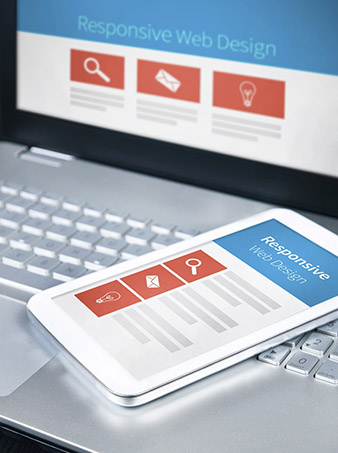 The myriad of mobile platforms has posed a significant hurdle for web developers and businesses. The iPhone, Blackberry, Android, netbook, and Kindle each come with their own screen resolutions and orientation; thus, websites need to be compatible with every new device. Yet not adapting to these new screen resolutions and interfaces loses customers and diminishes your business's visibility in the market.But making a new website for each new device is time-consuming, costly, and impractical.
Responsive web design adapts to the environment and user behavior. Using a range of flexible grids and layouts, a responsive web page adapts on account of screen size, platform, and device orientation.
For example, depending on the user's device, the website adapts automatically and adjusts screen resolution and scripting abilities. Websites are now automatically responding to a user's preferences, eliminating the cumbersome need of different designs, code scripting, and for the multitude of devices.
Adjusting Screen Resolutions
The majority of new smartphone devices come with different screen sizes, functionality, and color tones. For example, the iPad can switch sizes instantly from landscape to portrait, depending how a user holds their phone. This requires a web page to adapt instantly to each orientation. But hundreds of different sizes exist and more are coming, making it impossible to accommodate them all. Responsive Web Design makes everything more flexible - images adjust automatically, screen resolutions fit the device, and web layouts never break.
Grids, Images, and Queries
Creating responsive websites requires three aspects that fit together to make the whole of responsive design. They are:
- Fluid grids
- Fluid Images
- Media Queries
Traditionally, websites were measured in pixels, but these fixed units failed to adapt to different sized screens. Responsive websites, however, are built with relative units such as percentages, which effectively transitions the webpage size to adjust to hundreds of screen resolutions from a variety of devices.Images that don't shrink within the confines of the fluid grid, appear too large, small, or break entirely. In other words, the content should fit the form. Fluid images, therefore, are refitted automatically to every screen resolution and orientation such as the iPad, iPhone, Blackberry, and Android. Media queries function as filters for CSS Technology. CSS solutions change styles to match individual devices and their characteristics such as display type, width, height, orientation and screen resolution. For example, if a page design is either too small or large, a media query can detect the incompatibility and use a CSS script to rearrange the site's content. This is particular helpful when fluid grids start to 'break' and no longer look appealing. This point when websites no longer look good or function as they are built to is called a "breakpoint". Media queries are applied to define these 'breakpoints' which automatically adjusts or fixes the problem.
Your Customers
A study done by Google, called Think Insights on Mobile, found there is a 61 percent chance that users abandon sites difficult to use. As mobile usage explodes and the smartphone penetrates, customers want the same experience from their phones as they get on their computers. Businesses that fail to adapt risk losing out a huge market hold and being outpaced by their competitors.
Responsive web design requires you to respond to the growing demands of consumers and the multitude of mobile devices, with only one website coded to meet them all. It saves bandwidth, decrease loading time, and be accessed from every mobile device. If losing customers, revenue, and reputation are things you want your business to avoid, then contact us today and find out how responsive web design can help you.